


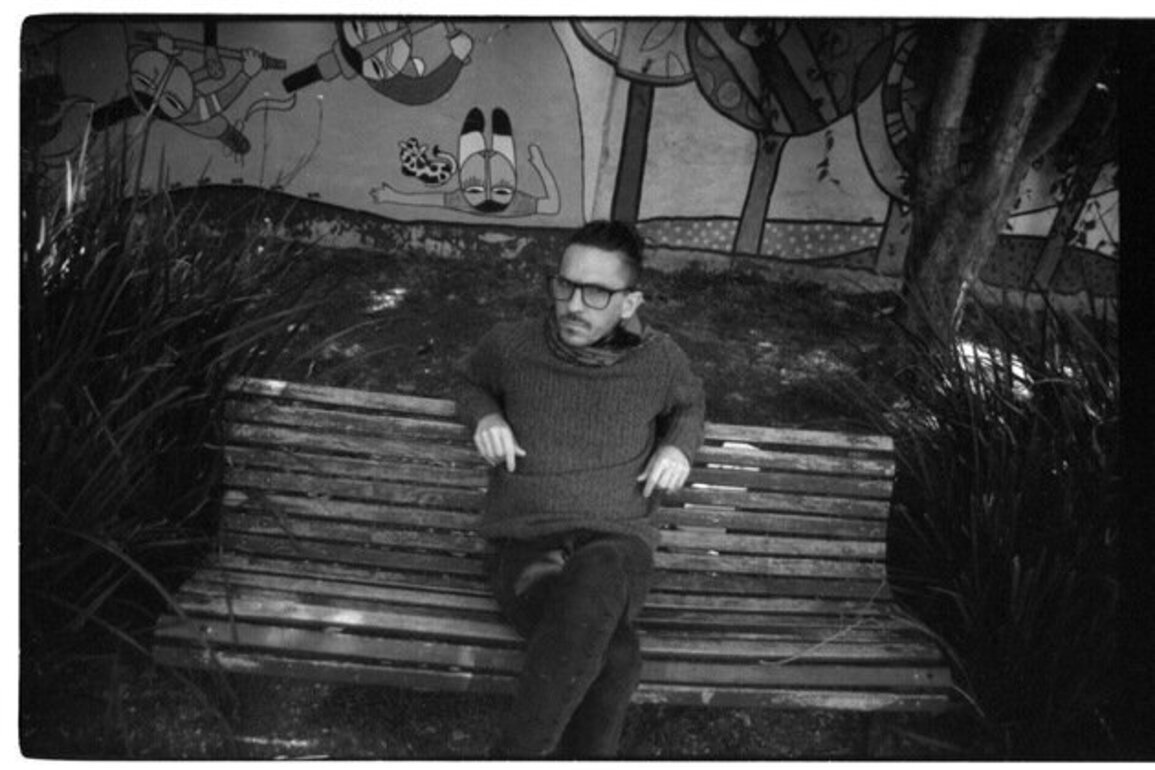
I have just finished reading the interview with Guido Zappacosta, and I am still moved by hearing his words. He answers with a kind of unguarded naturalness, as if each question opened a different door to memory, humor, or reflection. Perhaps that is also the image I have formed of him after reading his play Ahoradespus, a work presented at IATI Theater in New York from March 8 to March 15 and which may soon be touring other stages across Latin America.
Ahoradespus has something special about it: although it is written for the stage, it can also be read as an intimate experience. The voice that runs through the play creates an immediate closeness between the author and the audience. It is not only the themesthe relationship between father and son, soccer, deathbut the way they are told. As we move through its pages or listen to its story on stage, we feel as though we are walking through the authors memories: the vine that grows freely and stubbornly, the absurd and almost supernatural coincidences that happen to all of us at some point, and the quiet struggle to gain one more minute to share something with those we loveeven if it is just the shout of a goal. And if that goal is shouted in La Bombonera, then the moment seems to take on an almost sacred intensity.
After reading the play and speaking with its author, one gets the impression that theaterwhen it is honestworks like those conversations we never quite finish having with the people we love most. Perhaps that is why Ahoradespusresonates so strongly: because it speaks about what we leave for later when the present moment is already slipping away from us.
For now, dear readers, I can tell you that I have been invited to share amatewith Guido in Buenos Aires. But if you read the play or have the chance to see it performed, perhaps that mate will become collective. And who knowsmaybe we will all end up shouting Goal! together, for whoever it may be, but celebrating the same thing.
JS: Guido, lets start at the beginning. I always like to know where a writer comes from. Where does Guido Zappacosta come from, and when did your interest in theater begin?
GZ: I grew up in Martnez, in the northern area of the Province of Buenos Aires, between the Ro de la Plata and the RetiroTigre train line. I went to public school, earned a degree in Advertising (UCES), and later completed a diploma in Playwriting at the Paco Urondo Cultural Center of the University of Buenos Aires.
During my advertising studies I met a professor, Gabriel Penner, who ran literary workshops, and I signed up for one. Thats where I made my first attempts at writing, and he was the one who introduced me to the theater group in my neighborhood, the Teatro del Sindicato de Luz y Fuerza. Little by little I began getting closer to the group and eventually became part of it.
The theaters director, Leonel Filgiolo, asked me to write what would become the endofyear production for one of his groups, and thats when I wrote what I consider my first play, Pequea porcin de un mundo vertical. From that moment on I never stopped writing, dedicating my life to theater.
JS: More specifically, how did Ahoradespus come into being? Was there a personal experience, an image, or a story that sparked the idea for the play?
GZ: Ahoradespus was born in a monologuewriting workshop led by Fabin Daz during the pandemic in 2020. It was a virtual workshop that strongly encouraged my writing.
However, the seed of the play comes from a situation related to my fathers illness and death. When he was hospitalized during the final stage of cancer, his best friend went to visit him at the clinic. A few days later that friend died suddenly of pneumonia, and shortly afterward my father also passed away. Neither of them ever learned about the others death.
I lived with that situation since 2008, the year my father died, always with the desire to do something with that story. Eventually it found its way into this play, together with other autobiographical episodes.
JS: When someone reads something they really love, something curious happens: the author begins to feel almost like a friend. A kind of trust develops, as if we knew the person behind the words. That happened to me with Ahoradespus. How do you create that level of intimacy with an audience? And how does it feel when someonea complete stranger in New Yorksays to you, Guido, I feel like you are my friend?
GZ: I love that feeling. Its true: when I read or see something that deeply moves me, I often think, With this person I share a view of the worldwe could have a mate together (as we say in Argentina), we could be friends.
But I had never thought that people might feel that way about Ahoradespus. This is the first time someone has told me that.
If that happens, it may be because the play has a universal character. I dont say that myselfits something people have told me. The universal aspect comes from the fact that we are all children. We all have a father or a mother. Of course, not everyone necessarily has loving feelings toward those who raised them, and some people may have lost their parents at a very early age and never formed that bond.
But beyond those differences, many of us will accompany our parents through illness or death. We have all been in hospitals, in waiting rooms.
At the same time, I like to think that this play is a declaration of love toward those we consider family, toward our friendships and the people we cherish. In my view, that stands in contrast to what is happening in the world today with wars and the rise of the far right. For me those forces represent the opposite of love, and I hope Ahoradespus can become a place of refuge. Even though the story deals with tragedy, I believe it is told in a way that ultimately celebrates life.
JS: The play has something very special: we are faced with a deeply tragic situation, yet at the same time there are moments that make us laugh or even make us angry. Do you think that mixture is part of the essence of tragedy? That life itself is never purely sad or purely comic?
GZ: Yes, absolutely.
I think humor has the ability to make certain moments lighter or easier to digest. It reminds me of something the Argentine actor, writer, and director Martn Piroyansky once said in an interview. He explained that when filming a scene in a waiting room, for example after someone learns about a death, it is not always only tears and drama. In that same situation people may laugh, or absurd things may happen that momentarily pull us away from the drama.
I liked that idea very much. Sometimes we try to portray drama only through sorrow and tragedy, but life is always that mixture of emotions.
In my playwriting I always try to combine drama with touches of humor or irony.
JS: Soccer plays a central role in the play. Boca Juniors and La Bombonera are almost universal symbols. Why does soccer become such an important element of the story? Is it mainly about the bond between father and son, or were you also exploring other layers?
GZ: In realistic and autobiographical terms, soccerand Boca Juniorswas one of the passions I shared with my father for many years.
Connecting this with the earlier question about how the play emerged, one powerful memory is the first and only time we went to the stadium together. I remember my father climbing the stairs exhausted, barely able physically, yet giving everything he had just to share that moment with me. He was already sick, but despite everything it was important for him to see Boca with me.
At the same time, soccer in Argentina is part of our popular culture. It is something that brings us together. In that sense it became a beautiful way to portray the bond between a father and a son.
Among men, expressions of affection can sometimes be difficultsaying I love you, or as the play says, talking about the things of the heart. But without saying anything, going to the stadium together or sharing a choripn in that context can also be a way of saying I love you.
JS: My favorite scene is when the narrator describes the soccer match. I wont reveal what happens because I think the audience should discover it themselves. But even knowing what happens, someone could see the play many times and still feel the same emotions. Why does that happen in theater? Why does a story we already know continue to affect us every time we see it?
GZ: Some of the questions you ask reveal things about the play that I did not know were happening. I do know that many people have seen it more than once, that they recommend it, and that they want to see it again. But I cannot fully explain why.
From the beginning I felt it was important to constantly anticipate what would happento foreshadow the ending, to let the audience know that the story ends in death. What we witness is precisely that final stage of a relationship.
What becomes moving is accompanying that final stretch: the emotions of a young man becoming an adult. Alongside that there are also beautiful elements, such as the vine that appears in the play, which represents life continuing its course.
Sometimes when we hear about someones death, at the same time someone around us becomes pregnant or a baby is born. I think the sadness of the drama is balanced by that vine that eventually covers the stage entirely, as a kind of vital and hopeful cry.
JS: In Colombia, we also have a very emotional relationship with soccer, with fathers, and with family stories. Are you surprised that such an Argentine story can feel so universal?
GZ: Yes, honestly it surprises and moves me a great deal. I never expected everything that has happened with the play.
In addition to Argentina, the play has been staged in Uruguay, Colombia, the United States, and Mexico, and it is currently in preproduction in Peru, Brazil, and Spain.
In some countries, like Mexicoand likely Spain as wellthe play has been adapted slightly in terms of settings, expressions, and certain situations. But the essence remains the same.
JS: The title Ahoradespusseems to refer to words we keep to ourselves and feelings we postpone for later. But at the same time there is also a now. Do you think this difficulty in expressing emotionsespecially among menis cultural?
GZ: Yes, culturallyat least in Argentinait is more difficult for men to express what we feel. Hugging or physical affection is much more socially accepted among women.
The same happens with crying. Women are allowed to cry, but boys often grow up hearing that men dont cry, or that crying is something for women. Those ideas now seem terrible to me, and fortunately the play challenges them.
I honestly dont have clear memories of seeing my father cry.
Still, I believe that among men there are other codes through which affection is expressed. In one moment of the play it says something like: between jokes and insults they are always saying the same thing: I love you, my frienddont die now or ever.
Even though we can be clumsy in expressing it, behind jokes and irony we often show affection. And thats valid too.
JS: The play is performed as a monologue with a single actor. What were you looking for with that choice?
GZ: When I wrote the play, I didnt think much about how it would be staged. I felt more the need to record this story, almost like writing a short story.
The text actually contains no stage directions. Its published and can be read by people who havent seen the play or who may not even like theater.
I thought it would be interesting to have the entire story embodied by one actor, so that we could see that solitudethe loneliness of facing overwhelming emotionsrepresented in a single body.
JS: After so many performances and international productions, what surprises you most about the audiences reactions?
GZ: What moves me the most is seeing that audiences in different countries respond in very similar ways, valuing the feelings of love toward the people in their lives.
I often hear that people leave the theater and hug their parents, or call someone to express their feelings.
Thats when I realize that theater really does serve a purpose. Sometimes we struggle to find meaning in what we do, but in those moments theater becomes action. I love being part of that production of emotions.
If someone sits in a theater seat and laughs, cries, or leaves thinking or feeling somethingthat is already a lot. That is mission accomplished.
JS: Finally, what new projects are you working on? And how is theater doing in Argentina today?
GZ: In April a new play I wrote will premiere: CURUZA, a flor de piel, created for the Argentine actress Marina Casillo and based largely on her personal story related to a skin allergy.
Another play, tentatively titled Casi lista, which I co-wrote with the actress Amarella, is scheduled to premiere in the second half of the year.
I also have another play called Huracn, which I hope will premiere this year under the direction of Lucas Santa Ana.
At the same time, I continue working on La Santa Rita, which I co-wrote with Evangelina Ferreira and directed; La lucirnaga que ilumin la noche, also written and directed by me; and today Im beginning rehearsals for a revival of my play Love, a Slow-Cooked Stew (El amor, un guiso a fuego lento).
As for theater in Argentina, Im glad to think that despite the worst crises we will continue making theater however we cancreating with what we dont have. That is something characteristic of us: we keep going despite adversity.
The current political context is bleak, and this government administration has dismantled many things, which can be felt in theaters. At the same time, people still have a strong desire to gather, to meet in person, and to value encounters that are not mediated by screens.
For me, that is our strengthand where we must focus if we want to keep bringing audiences together despite the difficult national and global situation.
JS: Thanks, my friend
Jhon Snchez