

BUENOS AIRES (CN) - In 2015, when Loy Joseph, 29, spent her first Christmas in Argentina, she cried through most of it. The following year was not much different. Haiti felt impossibly far from Rio Negro, the Patagonian province where she had landed, speaking little Spanish and unsure whether she would stay.
By December 2024, the homesickness had changed shape. Joseph conducted the gospel choir she now directs for the first time. The room filled with harmonies that sounded both Caribbean and Patagonian.
"Art saved me from the depression that came with realizing the reality of being a migrant," she said from her home in southern Argentina.
For years, Argentina became an unlikely destination for Haitians fleeing political collapse, gang violence, earthquakes and economic hardship. Unlike the United States, Chile or Brazil, Argentina never received Haitians in large numbers. The country's 2022 census counted just 1,524 Haitian-born residents, a smaller community than migrants from Japan or Portugal.
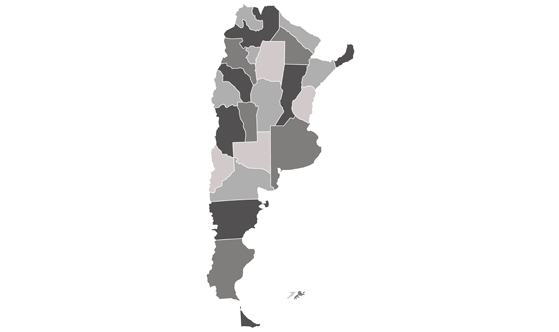
Still, Haitian migrants built lasting communities across Argentina's interior provinces - from a gospel choir in Patagonia to a stand-up show in Mendoza, a Haitian Revolution commemoration in Cordoba and a memoir written in Rosario.
Many Haitians who arrived about a decade ago say attitudes toward migrants across the region have hardened in recent years, making daily life feel more uncertain. Even so, many continue building cultural spaces and support networks rooted in music, language and shared traditions.
"We feel expelled, but this is home to us," said Eddyson Damas, a 30-year-old activist and founder of the Haitian cultural organization KONBIT in Cordoba. He arrived in Argentina in 2016, shortly after finishing high school in Haiti. Like many Haitians who came during that period, he arrived to attend university.
At the time, Argentina had one of Latin America's most progressive migration systems. A 2004 law declared migration an essential human right and guaranteed access to health care and education regardless of immigration status.
That framework mattered, said Pablo Ceriani Cernadas, a migration and human rights expert. "But it sought to make regularization easier, and to recognize the rights of migrants."
After Haiti's devastating 2010 earthquake, migration routes expanded across South America. Brazil offered humanitarian visas, Chile's economy was booming, and Argentina, though poorer and more geographically distant, offered public universities and relatively accessible residency procedures.
Many Haitian migrants bypassed Buenos Aires altogether.
"They're highly dynamic migratory communities," said Carina Trabalon, a CONICET researcher who studied Haitian migration in Rosario and Cordoba, and pointed out that access to public universities was a big boost for those looking to build a future abroad.
In Cordoba, Damas found other Haitian students struggling with the same bureaucratic obstacle: validating their high school diplomas required passing exams in Argentine history, geography, civics and Spanish.
So they began studying together. Out of those meetings emerged KONBIT Club Cultural Haitiano, founded in 2017. Its first public event commemorated the anniversary of the Haitian Revolution.
"We needed a space of embrace for newcomers," Damas said.
The organization eventually expanded into language exchanges, cultural workshops and legal assistance for recent arrivals.
In Rosario, another group of Haitian students built similar support networks after discovering they had been scammed.

Even before the 2010 earthquake accelerated migration from Haiti, students had already begun arriving in Argentina. In December 2008, Maxonley Petit arrived believing his medical school enrollment and immigration paperwork had already been arranged. Instead, he and dozens of other Haitian students found themselves stranded, without housing or university placement.
"At the airport, you board the plane with hope," Petit said in an interview. "But displacement is always there."
Petit eventually stayed in Argentina for years, living in Rosario, Resistencia and Cordoba. He later published "La travesia de los olvidados" ("The Journey of the Forgotten"), a book mixing testimony and memoir about Haitian migrants in Argentina.
"We are a kind of invisible community," he said. "That's why we are the forgotten."
The invisibility cuts both ways. Argentina never experienced the same level of anti-Haitian political mobilization seen elsewhere in the Americas. Several migrants interviewed said everyday life in Argentina's provinces often felt unexpectedly familiar.
For Jasmine Daphinis, an anti-racist activist and stand-up comedian living in the central city of Mendoza, the resemblance was emotional rather than cultural.
"Mendoza feels like my country because it feels like a town," she said. But Mendoza's arid winemaking landscape is far from the Caribbean warmth of her homeland. "Once you gain their trust, you become one more mendocino."
Daphinis said Argentine feminist groups helped her rebuild her life after surviving sexual violence and abuse.
Today she teaches French, performs stand-up comedy about racism and migration, and leads the Haitian Migrant Network of Argentina. Through humor, she said, she tries to expose "the absurdity of racist practices."
"I know the preamble of the Constitution, I drink bitter mate, I make my own barbecue," she joked. "I even have the classic Cerro Arco picture."
Still, migrants describe a growing climate of uncertainty. In 2018, Argentina imposed visa requirements on Haitians, ending years of relatively open entry policies. Researchers and activists say airport rejections had already begun before the formal visa restrictions, often through arbitrary decisions that disproportionately affected Black travelers.

Laura Paredes, a coordinator at the migrant rights organization CAREF, said newer residency requirements have made it harder for some migrants to regularize their status.
"More people are being pushed into staying undocumented," she said. "Therefore, more vulnerable."
Paredes said migrants also face growing fears around police controls and deportation threats. Haitians often encounter additional barriers because they are not covered by the Mercosur residency agreements available to many South American migrants.
"And there's an intersection to it - because they're racialized, because Spanish is not their mother tongue, they are often more vulnerable to mistreatment by security forces," she said.
For many Haitian migrants, movement across borders has become increasingly difficult in recent years.
"We are not targeted only as migrants," said Damas. "There's a racist framework, too."
"There are people who stay not because they necessarily want to," Trabalon said, "but because international mobility itself has become inaccessible."
The precariousness is visible in daily life. Many migrants struggle to renew residency papers, obtain formal employment, or reunite with family members abroad.
In Rosario, Haitian migrants organized Creole-Spanish language exchanges and cultural festivals. In Cordoba, students turned study groups into institutions. In Patagonia, Joseph transformed loneliness into music.
The communities remain small enough that many Argentines have never knowingly met a Haitian person - or are unaware that they have. But their footprint stretches quietly across the country's provinces.
For Joseph, Christmas no longer arrives only with grief. "Now, we all get together to celebrate," she said. "We want to keep that spirit alive."
Lucia Cholakian Herrera is a Courthouse News correspondent based in Buenos Aires, Argentina.
Source: Courthouse News Service